
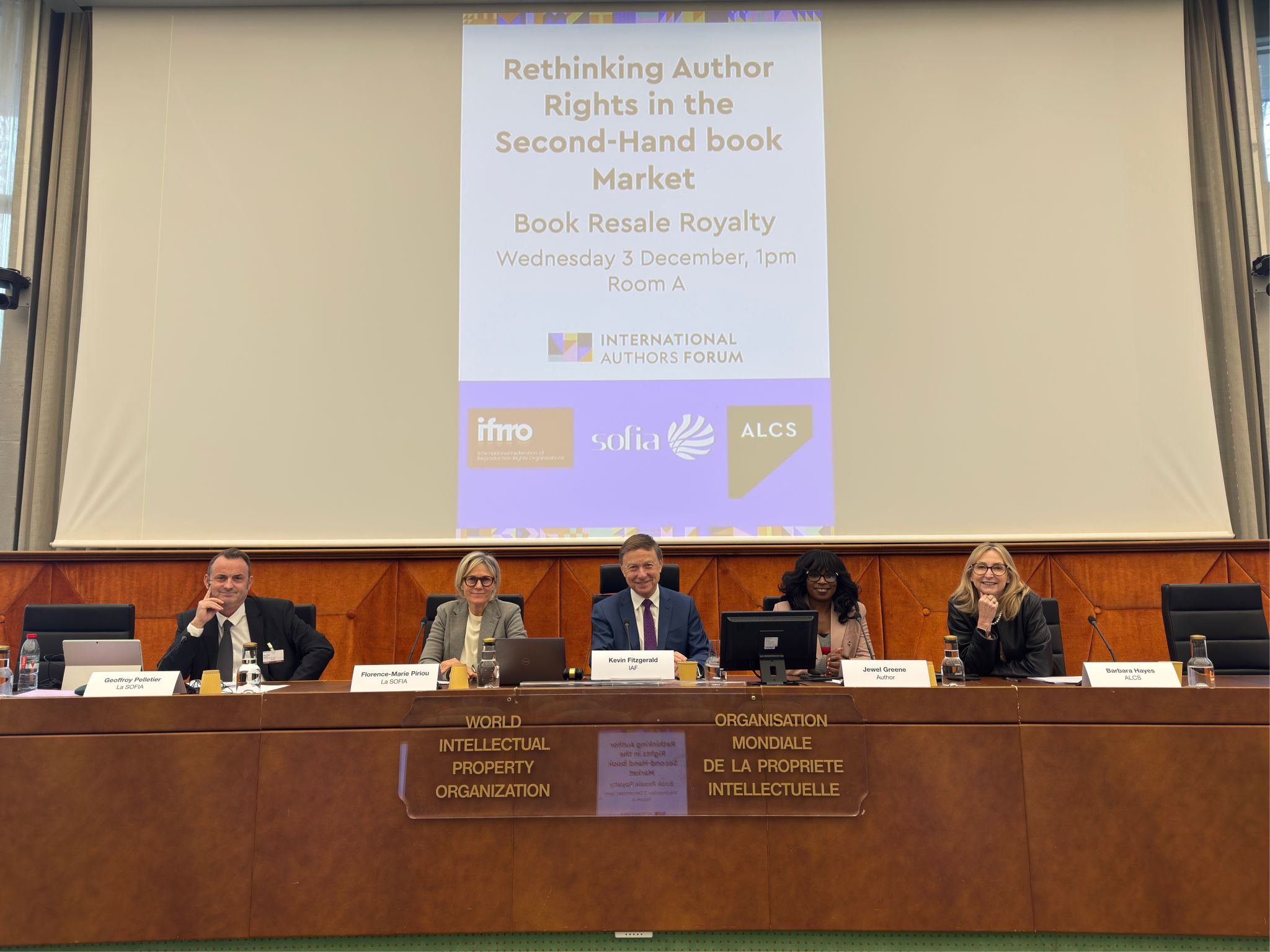
The International Authors Forum (IAF) organised a side event titled “Rethinking Authors’ Rights in the Second-Hand Book Market: Book Resale Royalty”, in collaboration with the International Federation of Reproduction Rights Organisations (IFRRO), the Authors’ Licencing and Collective Society (ALCS), and La Sofia, at the 47th Session of the WIPO Standing Committee on Copyright and Related Rights (SCCR) last December. The event brought together authors, collecting societies representatives, and legal experts to examine the growing impact of the second-hand book market on authors’ livelihoods and explore solutions for fair compensation.
Opening the session, Geoffroy Pelletier, Chief Executive of La Sofia, presented findings from a French economic study in collaboration with the French Ministry of Economy, showing that the resale of used books represents €350 million in value in just one market alone, with authors potentially missing out on €16 million, an amount comparable to the revenue they receive from public lending rights. The study also highlighted that resale often replaces the purchase of new copies, meaning these losses directly reduce creators’ income. These figures underscored the scale of the issue and the urgent need for frameworks that ensure authors benefit from the ongoing circulation of their works.
Florence Marie Piriu, Secretary General of La Sofia, outlined how the “exhaustion of distribution rights” principle, originally designed to enable free movement of goods, no longer reflects today’s digital and platform-driven resale economy. She pointed to existing exceptions, such as resale royalties for visual artists, public lending rights, and private copying levies, as evidence that compensation mechanisms can coexist with market access. A proposed book resale royalty, framed as fair remuneration rather than a restriction on resale, was discussed as a possible way forward.
Barbara Hayes, Chief Executive of ALCS, described the UK’s Author Share initiative, a voluntary scheme ensuring authors are remunerated when their books are resold. In partnership with booksellers like World of Books and Book Barn International, it has distributed payments to thousands of authors, amounting to under £500,000 annually. While modest, these payments demonstrate the principle that creative work continues to generate value long after first sale. Barbara emphasised collaboration, transparency, and governance, noting, “The easy thing is to do nothing. The right thing is to have these discussions and see what’s possible.”
Author Jewel Greene, President of the Trinidad and Tobago Writers Guild, offered a Caribbean perspective, highlighting how authors in smaller markets are only beginning to understand the scale and impact of second-hand book resales. She noted that access to data has been crucial in shifting perceptions, helping writers see resale royalties not as minor sums but as a potential path toward sustainable, full-time authorship. Green emphasised the need for further research, awareness, and policy dialogue so authors across the Caribbean can participate fairly in emerging resale frameworks.
Key takeaways included the importance of ongoing research, international collaboration, and continued dialogue. With studies underway in multiple countries, participants emphasized that coordinated action will be crucial to ensure authors can sustain their creative work in the evolving global book market.
Watch the full event here: Rethinking Author Rights in the Second Hand book Market